
Many companies have a strategy but struggle to execute it consistently. Management may know which customers the business wants to serve, where future growth should come from and which competitive position the company wants to build. Yet inside the organization, responsibilities remain unclear, processes depend on individuals, departments work toward different priorities and managers spend too much time resolving operational problems.
This gap between strategy and daily execution is often an operating model problem.
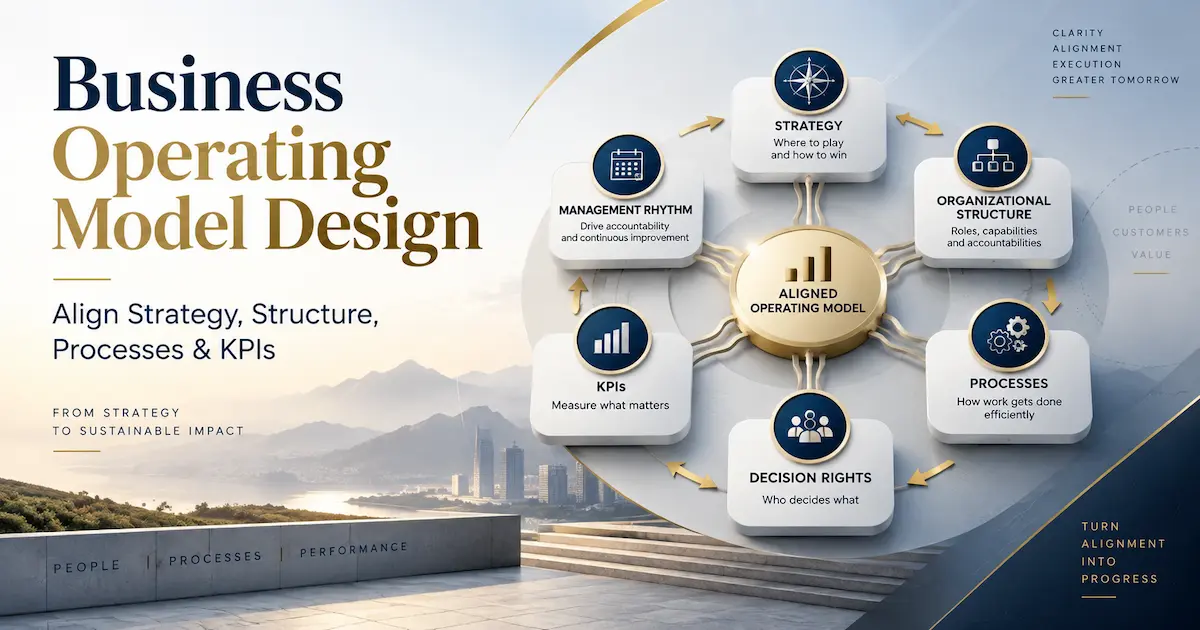
A business operating model defines how an organization converts its strategy into coordinated work. It connects organizational structure, roles, processes, decision-making authority, technology, management information and performance indicators into one coherent system.
The objective is not to create more procedures or bureaucracy. A good operating model should make the business easier to manage. Employees should understand what they own, managers should know which decisions belong to them, processes should move across departments with fewer delays and senior leadership should be able to monitor performance without becoming involved in every operational detail.
This guide explains how leaders can design a practical operating model, identify weaknesses in the current organization and build the management infrastructure required for scalable growth.
آنچه خواهید خواند:
Strategy Defines Where the Business Wants to Go. The Operating Model Defines How It Will Get There.
When strategy, structure, processes and performance management are designed separately, execution becomes fragmented. A strong operating model aligns these elements so that daily decisions support the company’s strategic direction.
What Is a Business Operating Model?
A business operating model describes how the organization works in practice. It translates strategic choices into responsibilities, processes, resources, systems and management routines.
Consider a company whose strategy is to deliver premium service to corporate clients. That strategic choice has implications throughout the organization. Sales may need stronger account qualification. Operations may require defined service standards. Customer support may need faster escalation. Managers may need KPIs related to retention and service quality rather than only revenue.
If those internal systems are not redesigned, the strategy remains a statement rather than an operating reality.
Organizations that are unsure whether the problem lies in strategy, sales, financial performance or internal execution may first benefit from a structured
business diagnostic framework
before redesigning the operating model.
Business Strategy vs. Business Operating Model
Strategy and operating model are closely connected, but they answer different questions.
| Area | Strategy | Operating Model |
|---|---|---|
| Main Question | Where will we compete and how will we win? | How must the organization work to execute that strategy? |
| Customer | Which customer segments will we serve? | How will teams serve those customers consistently? |
| Competitive Advantage | Why should customers choose us? | Which capabilities and processes deliver that advantage? |
| Resources | Where should resources be concentrated? | Who controls them and how are they deployed? |
| Measurement | What outcomes indicate strategic success? | Which KPIs and reviews monitor execution? |
Because operating-model choices should follow strategic choices, companies undertaking major organizational redesign should first clarify the direction established during
strategy development
.
10 Signs Your Business Operating Model Needs Redesign
- The CEO remains involved in too many routine decisions.
- Different departments have conflicting priorities.
- Customers experience inconsistent service across teams.
- Processes depend heavily on specific individuals.
- Responsibilities overlap and accountability is unclear.
- Managers spend significant time resolving cross-functional disputes.
- Growth increases complexity faster than profitability.
- Management reports contain data but do not guide decisions.
- Strategic initiatives continually lose priority to daily operations.
- Adding employees does not create a proportional increase in capacity.
The 6 Core Components of a Business Operating Model
An operating model should be designed as an integrated system rather than a collection of independent organizational projects.
1. Structure
How responsibilities are grouped into functions, teams, business units or regions.
2. Roles
Who owns which outcomes and where accountability begins and ends.
3. Processes
How work moves from one activity or department to another.
4. Decision Rights
Who can make, approve, recommend or escalate important decisions.
5. Performance Management
Which KPIs show whether the operating model is producing the expected outcomes.
6. Management Rhythm
When managers review performance, make decisions and coordinate priorities.
1. Design Organizational Structure Around Value Creation
An organizational chart should not begin with titles. It should begin with the work required to create value for customers and achieve the strategy.
For example, a company may require strong capabilities in customer acquisition, product development, project delivery, customer success and financial control. Structure should make ownership of those capabilities visible.
As companies grow, one common mistake is adding managerial layers every time workload increases. This can create hierarchy without solving the actual coordination problem.
Before creating a new department or management position, leadership should ask whether the real problem is insufficient capacity, unclear responsibility, weak process design or poor decision rights.
2. Define Roles Through Outcomes, Not Job Titles
Titles such as Sales Manager, Operations Director or Business Development Manager do not automatically create accountability. The organization must define the outcomes each role owns.
A Sales Director, for example, might own qualified pipeline, conversion, revenue quality and sales-team capability. An Operations Manager might own delivery reliability, capacity utilization, quality and operational cost.
The stronger the operating model, the easier it is to answer a simple question: who is accountable for this result?
If several managers believe another department owns the same outcome, execution becomes slow. If several managers believe they all own the final decision, conflict becomes likely.
The Accountability Test
What result does the role own?
Which decisions can the role make?
Which people, budget or systems can it use?
Which indicators show whether the role is succeeding?
3. Design End-to-End Business Processes
Customers do not experience departments. They experience a sequence of activities across the business.
A customer may move from marketing to sales, from sales to contracting, from contracting to operations and from delivery to customer support. If each department optimizes only its own work, the total customer journey can remain inefficient.
Operating-model design should therefore identify important end-to-end processes such as lead-to-customer, order-to-cash, product-development-to-launch, hire-to-productivity and issue-to-resolution.
For each process, management should define the owner, major stages, handoffs, standards, information requirements and performance measures.
The objective is not to document every possible action. The objective is to make important work repeatable enough that business performance does not depend entirely on individual memory.
| Process | Primary Question | Example KPI |
|---|---|---|
| Lead-to-Customer | How efficiently do we convert demand into profitable customers? | Conversion rate |
| Order-to-Cash | How quickly do we convert orders into collected cash? | Cash conversion time |
| Delivery | Can we deliver the promised customer outcome reliably? | On-time delivery |
| Customer Retention | Are valuable customers continuing the relationship? | Retention rate |
4. Make Decision Rights Explicit
Organizations often describe decision problems as communication problems. In reality, the issue may be that nobody knows who has final authority.
Which manager can approve a discount? Who decides whether a new employee is required? Who can select a supplier? Who owns pricing? Who approves changes to a customer contract?
When these questions are unclear, the organization either slows down while waiting for senior approval or different departments make inconsistent decisions.
A practical operating model defines where consultation is required, where approval is required and where managers are expected to decide independently. Higher-impact and less reversible decisions should generally receive greater senior-management involvement than routine operational choices.
What Should Be Centralized and What Should Be Decentralized?
A scalable operating model does not automatically decentralize everything. Some activities benefit from central control, while others create more value when decisions remain close to customers or operations.
| Centralization May Help When | Decentralization May Help When |
|---|---|
| Consistency is strategically important | Local customer knowledge matters |
| Specialized capability is expensive to duplicate | Speed of response creates value |
| Financial or regulatory risk is high | Decisions are low risk and reversible |
| Scale can reduce cost | Different markets require adaptation |
5. Connect the Operating Model to KPIs
Structure and process alone do not create accountability. Managers need evidence showing whether the operating model is producing the desired outcomes.
A common mistake is measuring departments only through activity. Marketing reports the number of campaigns, sales reports calls, operations reports completed tasks and HR reports training hours. These numbers may describe effort without showing whether business performance is improving.
KPIs should connect activity with business outcomes. Sales might track pipeline, conversion and average deal value. Operations might track delivery reliability, capacity and cost. Customer teams might track retention, repeat business and service performance.
A structured
management dashboard
can give executives visibility across these dimensions without requiring them to manage individual tasks.
Every Important KPI Should Have Four Elements
What exactly does the metric measure?
What level indicates acceptable performance?
Who is accountable for influencing the result?
What happens when performance moves outside the expected range?
6. Create a Management Rhythm That Supports the Model
Even a well-designed organizational structure can fail if management does not have a recurring mechanism for reviewing performance and resolving cross-functional issues.
The operating model should specify which management conversations occur weekly, monthly and quarterly. Weekly reviews may concentrate on execution and short-term exceptions. Monthly reviews can examine financial and operational performance. Quarterly discussions can review strategic assumptions and resource allocation.
The purpose is not to increase meeting volume. It is to ensure that different types of decisions have a predictable forum.
For a detailed framework, see the guide to building a
management operating rhythm
.
Where Does Technology Fit Into the Operating Model?
Technology should enable the operating model rather than define it.
A company may implement a CRM, ERP, project-management platform or business-intelligence system and still experience weak execution because roles and processes remain unclear.
Before selecting technology, management should understand the process the system will support, the information required, who will use it and which decisions it should improve.
Otherwise, technology can digitize an inefficient process rather than improve the way the organization operates.
Why the Operating Model Becomes More Important as a Business Scales
Small businesses often succeed through informal coordination. Employees speak directly with the founder, decisions are made quickly and experienced individuals compensate for weak processes.
Growth changes this environment. More customers create more exceptions. More employees create more handoffs. More products create more complexity. More locations create greater distance between senior management and frontline activity.
If the operating model does not evolve, growth can reduce rather than improve performance. Revenue rises while margins decline. Headcount increases while productivity falls. Managers spend more time coordinating work instead of developing the business.
Scalability therefore requires the company to replace some informal coordination with clear ownership, repeatable processes and management information.
The Scalable Operating Model
People know which results they are accountable for.
Important work does not depend completely on individual memory.
Routine decisions can be made without unnecessary executive escalation.
Leadership can detect problems through meaningful indicators.
How to Design a Business Operating Model: 8 Practical Steps
Step 1: Clarify Strategic Priorities
Identify the customers, competitive priorities and growth objectives that the organization must support. Operating-model design without strategy usually produces organizational changes without a clear business purpose.
Step 2: Map How Value Is Created
Describe the major activities required to attract customers, deliver the product or service, collect revenue and maintain the relationship. This creates the foundation for process and accountability design.
Step 3: Identify Current Bottlenecks
Look for repeated delays, duplicated work, unclear ownership, excessive approvals, customer complaints and processes that rely heavily on senior management.
Step 4: Define Critical Capabilities
Determine which capabilities are essential for the strategy. A company pursuing premium service may need superior account management and service delivery. A company competing through efficiency may require stronger process control and procurement.
Step 5: Redesign Roles and Structure
Group responsibilities logically and ensure every important business outcome has visible ownership. Avoid designing roles around particular individuals when possible.
Step 6: Define Decision Rights
Identify recurring decisions and determine which organizational level should make them. Establish thresholds for issues requiring executive involvement.
Step 7: Establish KPIs and Management Reviews
Connect each major business outcome to a measurable indicator and define when management will review performance.
Step 8: Implement in Phases
Avoid changing every role, process and system simultaneously. Prioritize the operating-model changes that address the largest constraints and use experience from implementation to refine the design.
A 90-Day Operating Model Redesign Roadmap
Review strategy, organization, major processes, performance data and management bottlenecks.
Define target structure, role accountability, process ownership and decision rights.
Launch priority changes, communicate responsibilities and introduce required management tools.
Review KPIs, resolve role conflicts and refine processes based on operating experience.
Common Mistakes in Operating Model Design
Copying Another Company’s Structure
An organizational structure that works for another business may reflect a different strategy, scale, market and management capability. Benchmarking can provide ideas, but the operating model should be designed around the company’s own requirements.
Starting With Job Titles
Creating impressive titles does not solve accountability problems. Start with outcomes, capabilities and processes before deciding how roles should be named.
Overengineering Processes
Too much documentation can create bureaucracy and reduce flexibility. Standardize the activities where consistency creates value and preserve managerial judgment where adaptation is important.
Changing the Organization Without Changing KPIs
If the company redesigns roles but continues measuring employees using old indicators, behavior may not change.
Ignoring Management Capability
A decentralized structure requires managers who can make decisions and accept accountability. The operating model must reflect the actual capability of the management team while creating a path for development.
When Should a Company Redesign Its Operating Model?
Operating-model redesign should be driven by business need rather than organizational fashion.
Typical triggers include rapid growth, entry into new markets, acquisition, digital transformation, significant changes in strategy, repeated profitability problems, expansion into multiple locations or increasing dependence on the CEO.
A redesign may also be appropriate when the company has reached a growth plateau. Management may initially believe that more marketing or sales capacity is required, when the real limitation is the organization’s ability to deliver and manage additional business.
The question should therefore be: does the current organization still support the strategy and scale we are trying to achieve?
How to Measure Whether the New Operating Model Is Working
Success should be evaluated using business and organizational indicators rather than simply checking whether a new structure has been implemented.
- Reduced decision-making time
- Fewer issues escalated unnecessarily to senior management
- Improved process cycle time
- Higher on-time delivery or service reliability
- Improved customer retention
- Greater employee productivity
- More predictable financial performance
- Clearer ownership of cross-functional outcomes
- More management time devoted to strategy instead of routine approvals
Not every improvement will appear immediately. The objective during the first months is often to establish clearer accountability and detect whether decision speed and execution quality are moving in the right direction.
How Business Consulting Supports Operating Model Design
Operating-model problems are difficult to diagnose from inside the organization because managers naturally see the business from the perspective of their own function.
Sales may believe operations is too slow. Operations may believe sales makes unrealistic commitments. Finance may believe both teams ignore profitability. Senior management may see each issue separately even though they are connected through one underlying operating model.
An external consultant can help examine the business across functions, distinguish structural issues from individual performance problems and identify where strategy, authority, processes and measurement are misaligned.
A professional
business consulting
engagement can then translate the diagnosis into a prioritized implementation roadmap rather than treating organizational design as an isolated HR exercise.
Business Operating Model Checklist
- Is the company’s strategy clear enough to guide organizational design?
- Does every critical business outcome have one accountable owner?
- Are important end-to-end processes defined?
- Are cross-functional handoffs working effectively?
- Are recurring decision rights clear?
- Are unnecessary executive approvals being removed?
- Do KPIs measure outcomes rather than only activity?
- Does management have a regular performance-review rhythm?
- Does technology support the process rather than complicate it?
- Can the organization grow without creating proportional management complexity?
Final Thoughts: Build an Organization That Can Execute the Strategy
A strong strategy can fail when the organization is not designed to execute it. Growth can become increasingly difficult when responsibilities overlap, processes depend on individuals, decisions continually move upward and managers lack reliable information.
Business operating model design addresses these problems as one interconnected system.
The process starts with strategy and value creation. It then defines the capabilities, structure, roles and processes required to deliver that value. Decision rights establish where authority should sit, while KPIs and management routines create visibility and accountability.
The best operating model is not necessarily the most sophisticated one. It is the model that allows the organization to make good decisions, coordinate work, serve customers consistently and grow without unnecessary complexity.
Ultimately, scalable businesses are not built by adding more people every time complexity increases. They are built by creating a system in which people, processes and management practices work together around a clear strategy.
Is Your Organization Ready for the Next Stage of Growth?
A structured business review can help identify weaknesses in organizational structure, processes, decision rights and performance management and develop a practical operating model for sustainable growth.