
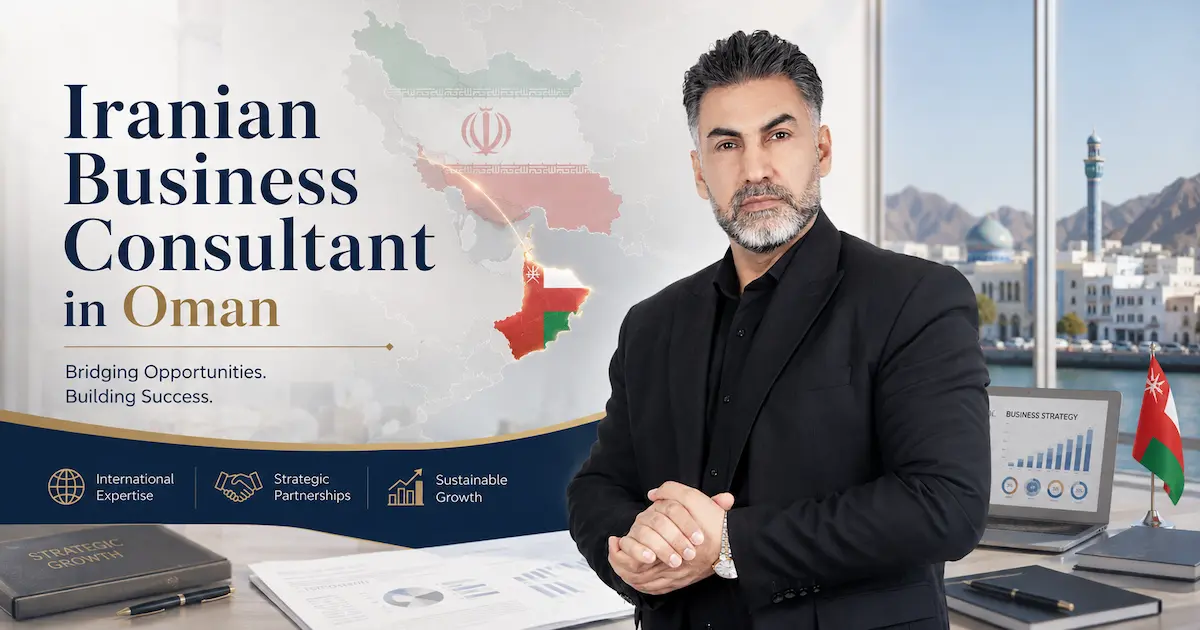
Expanding from Iran into Oman can appear straightforward at first. The two countries are geographically close, commercial connections exist across several industries, and many Iranian entrepreneurs already have products, technical expertise, professional services or business experience that could potentially be introduced to the Omani market.
Yet geographic proximity does not mean that the two markets operate in the same way. Customer expectations, competitive conditions, business communication, pricing structures, partnership models, procurement processes, regulatory requirements and management practices can differ significantly. A business model that performs well in Iran may therefore require substantial adaptation before it can compete effectively in Oman.
This is where working with an Iranian Business Consultant in Oman can create strategic value. The role is not merely to translate language or help complete administrative procedures. A capable consultant should help business owners translate their existing experience into a commercial model that is suitable for the Omani market.
This guide explains how Iranian entrepreneurs and companies can use business consulting to evaluate opportunities, reduce market-entry mistakes, select the right customer segments, localize their value proposition, design a B2B sales process and create a more disciplined path from market exploration to sustainable growth.
Iran → Oman Business Principle
آنچه خواهید خواند:
Successful Market Entry Requires Translation of the Business Model, Not Just Translation of the Language
Iranian companies entering Oman should not simply reproduce the business model, pricing, sales message and management assumptions that worked in Iran. The stronger approach is to identify which capabilities can be transferred, which elements must be localized and which assumptions need to be tested before major investment.
What Does an Iranian Business Consultant in Oman Actually Do?
A business consultant works on the commercial and managerial questions behind a business. For an Iranian entrepreneur considering Oman, these questions may begin before the company is registered.
Is there sufficient demand for the planned product or service? Which customer segment should be targeted first? Is direct market entry appropriate, or would a distributor, local partner or pilot project create less risk? How should the offer be positioned? What sales process is realistic? What level of investment will be required before the business generates stable revenue?
For an existing Iranian-owned company already operating in Oman, the questions may be different. Management may need to understand why sales remain below target, whether pricing is appropriate, why customer acquisition is slow, whether the organizational structure is efficient or whether expansion should continue.
A broader explanation of the consultant’s role is available in the site’s guide to
business consulting in Oman
.
The focus of this article, however, is specifically on the business transition between Iran and Oman.
Why Does an Iran-to-Oman Perspective Matter?
An entrepreneur can understand a market technically and still underestimate the practical difficulties of transferring a business from one commercial environment to another. The strongest cross-border consulting therefore requires an understanding of both the starting point and the destination.
Understanding the Entrepreneur’s Existing Business Reality
An Iranian company may already have suppliers, production capacity, technical staff, customer relationships, intellectual property or a successful domestic sales model. A consultant should first understand these assets rather than immediately proposing a completely new model.
Understanding What Cannot Simply Be Copied
The same offer may require different pricing, packaging, communication, service expectations or distribution arrangements in Oman. Even when the technical product is unchanged, the commercial proposition may need to be redesigned.
Recognizing Common Cross-Border Assumptions
Entrepreneurs sometimes assume that geographical proximity automatically creates customer demand. Others assume that an existing contact can become an effective commercial partner. These assumptions should be tested before significant capital is committed.
Business Consultant vs. Company Formation Agent
One of the most important distinctions for Iranian investors is the difference between establishing a legal entity and establishing a viable business.
| Area | Company Formation Support | Business Consulting |
|---|---|---|
| Main Objective | Create the legal entity | Create a commercially viable business model |
| Market Research | Usually limited | Customer, competition and opportunity analysis |
| Business Model | Not usually the core scope | Revenue, costs, positioning and operating model |
| Sales Strategy | Usually outside scope | Target accounts, channels and sales process |
| Growth Support | Normally ends after setup | Can continue through execution and scaling |
Entrepreneurs specifically researching the administrative side can separately review the guide to
company registration in Oman for Iranians
.
8 Areas Where an Iranian Business Consultant in Oman Can Add Value
1. Market Feasibility Analysis
The first responsibility is often to determine whether the proposed opportunity deserves further investment. The consultant can help define the addressable customer segment, existing alternatives, competitive intensity, buying criteria and probable barriers to entry.
2. Customer Segmentation
“Oman” is not a customer segment. A company should determine whether it is targeting private consumers, SMEs, corporate buyers, industrial companies, distributors, contractors, hospitality companies or other specific groups. Each segment requires different channels, pricing and sales methods.
3. Market-Entry Strategy
Management must decide how much commitment is appropriate during the first stage. A limited pilot, distributor model, direct company establishment or strategic partnership can create very different levels of investment and control.
4. Business Model Adaptation
An Iranian business model may depend on assumptions around cost structure, payment terms, staffing, delivery, customer acquisition or pricing that do not transfer directly. These assumptions should be rebuilt for the Omani environment.
5. Positioning and Value Proposition
Customers need a clear reason to select a new entrant instead of established local or international alternatives. The answer should go beyond “high quality” or “competitive price.” A strong value proposition identifies a specific customer problem and a credible reason why the company can solve it better.
6. Sales Process Design
For B2B companies, the consultant can help define prospect qualification, decision-maker mapping, first contact, discovery meetings, proposal structure, negotiation and follow-up. Market entry becomes measurable when each opportunity has a defined stage.
7. Partner and Distributor Evaluation
A local contact is not necessarily a suitable commercial partner. Potential partners should be assessed based on industry capability, customer access, reputation, resources, competing products, financial capacity and willingness to invest in market development.
8. Management and Performance Systems
Once operations begin, management needs KPIs covering pipeline, conversion, revenue, margin, cash collection, customer retention and strategic milestones. Without these indicators, management may confuse activity with progress.
The Iran-to-Oman Business Translation Framework
Which capabilities from the existing Iranian business should remain unchanged?
Which elements need to change for Omani customers and commercial conditions?
Which assumptions should be validated before significant investment?
Which new capabilities must be created locally?
Common Mistakes an Iranian Business Consultant Should Help Prevent
Good consulting should not only identify opportunities. It should also prevent expensive mistakes.
Assuming Success in Iran Proves Demand in Oman
Existing success is evidence that the company has capability, but it does not automatically prove that Omani customers have the same problem, buying behavior or willingness to pay.
Registering First and Researching Later
Company formation can create psychological commitment. Once money has been spent on establishment, offices and staffing, management may feel forced to continue even when market evidence is weak.
Selecting a Partner Based on Personal Chemistry
Trust matters, but partnership decisions should also include commercial due diligence. The partner must have the capability and incentives required to produce measurable market results.
Competing Primarily Through Low Price
Price may be important, but entering a market purely as the cheaper alternative can create weak margins and little customer loyalty. Reliability, specialization, service, availability and risk reduction can create stronger differentiation.
A more detailed discussion of these risks is available in
Common Mistakes Iranians Make When Starting a Business in Oman
.
10 Questions to Answer Before Investing in Oman
- Who is the first customer segment we want to win?
- What specific problem will we solve for that segment?
- Who currently solves that problem?
- Why should an Omani customer switch to us?
- What price can the market realistically support?
- Which costs will change compared with Iran?
- Do we need direct presence, a partner or a distributor?
- How long is the expected sales cycle?
- How much capital is required before break-even?
- Which results would tell us to expand, modify or stop the project?
A Practical Consulting Process for Iranian Companies Entering Oman
Step 1: Define the Strategic Question
The project should start with a decision rather than a general request for “market information.” Examples include: Should we enter Oman this year? Which customer segment should we target first? Should we use a distributor or establish direct operations?
Step 2: Diagnose the Existing Business
The consultant should understand the company’s products, margins, customers, capabilities, supply chain, management structure and reasons for considering Oman.
Step 3: Analyze the Omani Opportunity
Research should examine customers, competitors, pricing, available alternatives, market channels, buyer requirements and barriers to entry.
Step 4: Compare Entry Options
Rather than automatically recommending company establishment, management should compare several realistic options based on investment, speed, risk, control and learning potential.
Step 5: Design the Commercial Model
The business then defines target customers, value proposition, pricing, sales channels, delivery model, customer support and key financial assumptions.
Step 6: Build the 90-Day Action Plan
Recommendations should become specific actions with owners, deadlines and measurable milestones. Consulting has limited value when the output is only a presentation.
Example: First 90 Days of an Iran-to-Oman Market Entry Project
Business diagnosis, objectives, product assessment and definition of the target market question.
Customer segmentation, competitor analysis, pricing research and partner mapping.
Market-entry model, value proposition, financial assumptions and sales strategy.
Pilot implementation, prospect development, KPI tracking and management review.
Iranian Business Consulting for B2B Companies in Oman
The role of consulting becomes particularly important for Iranian manufacturers, exporters, engineering firms, technology providers and professional service companies targeting B2B customers.
B2B market entry usually requires more than advertising. The company must identify qualified organizations, understand the buying process, find the correct technical and commercial decision-makers, demonstrate credibility and manage a longer sales cycle.
The consultant can help define an ideal customer profile so the company focuses on organizations that have both a genuine need and the capacity to buy. This prevents sales teams from spending months contacting companies with little commercial potential.
Companies targeting corporate buyers can also use the site’s detailed guide to
B2B sales in Oman
to structure prospecting, qualification, proposals, negotiation and account development.
Localization Is More Than Translating Persian Into Arabic or English
Companies sometimes treat localization as a language project. Language matters, but commercial localization is broader.
A proposal designed for Iranian customers may emphasize features that are not the highest priority for an Omani buyer. Delivery expectations may differ. Decision-makers may require different proof of credibility. Contract terms, warranties, after-sales service and presentation quality may influence the buying decision more heavily.
Brand positioning may also require adjustment. A company known in Iran cannot assume the same reputation exists in Oman. It may need to rebuild trust from zero through professional communication, references, partnerships, technical documentation and consistent service.
Effective localization therefore asks a strategic question: how should the business appear, communicate and operate so that the target customer perceives it as credible and relevant?
How Should Iranian Companies Evaluate an Omani Business Partner?
Choosing a partner is one of the highest-risk decisions in market entry. An attractive introduction or a large contact list does not prove that the individual or company can develop the market.
Management should evaluate the partner’s industry experience, existing customer relationships, sales resources, reputation, operational capacity, financial expectations and conflicts with competing products or services.
The commercial agreement should also define responsibilities. Who generates leads? Who attends meetings? Who handles quotations? Who provides technical support? Which party funds marketing? What sales targets are expected?
Exclusivity should be approached carefully. Granting broad exclusive rights before the partner demonstrates performance can reduce the company’s ability to develop alternative channels.
Financial Planning Before Market Entry
Market demand alone is not enough. The business also needs an economic model that can support sustainable operation.
Management should model revenue assumptions, gross margin, staffing, office or facility costs, logistics, professional services, marketing, customer acquisition, working capital and the time required to receive customer payments.
At least three scenarios are useful: a conservative case, an expected case and an upside case. The purpose is not to predict the future perfectly. It is to understand which assumptions determine whether the investment remains viable.
A consultant should challenge overly optimistic assumptions, particularly around how quickly customers will be acquired and how rapidly the business can reach stable revenue.
When Should You Hire an Iranian Business Consultant in Oman?
Professional consulting is most valuable when the decision has meaningful financial or strategic consequences.
When the company needs to validate demand and compare entry models.
When facilities, staffing, inventory or long-term commitments are required.
When market activity exists but conversion and revenue remain below expectations.
When management wants to expand customers, branches, products or commercial resources.
Should You Speak to a Business Consultant Before Registering a Company?
In many cases, yes. The reason is not that business consultants replace legal or company-formation specialists. They do not. The advantage is that commercial questions can be clarified before management commits to a structure.
For example, the desired operating model may affect location, staffing, capital requirements, partner strategy and even the type of commercial presence required.
Entrepreneurs approaching this stage can use
these questions to ask a business consultant before registering a company in Oman
as a complementary checklist.
How to Choose the Right Iranian Business Consultant in Oman
The right consultant should be selected based on the quality of the consulting process rather than promotional claims.
Look for Diagnostic Thinking
A consultant should ask questions before giving recommendations. If the same solution is offered to every business, the process is probably not genuinely strategic.
Evaluate Business Understanding
The consultant should understand business models, financial logic, market strategy, sales, organizational structure and execution—not only company formation procedures.
Expect Clear Deliverables
A professional engagement should clarify what will be analyzed, what decisions will be addressed, what outputs will be delivered and how progress will be measured.
Ask How Recommendations Will Be Implemented
A strong strategy that never reaches execution has limited value. Clarify whether the consultant will support management during implementation, KPI review and refinement.
Red Flags When Choosing a Business Consultant
- Guaranteed profit or guaranteed market success.
- Recommendations before understanding your business.
- No clear distinction between consulting and administrative services.
- No measurable project objectives.
- Heavy reliance on personal contacts without a market-development system.
- No financial or commercial analysis.
- No implementation or follow-up mechanism.
A Business Consultant Does Not Replace Lawyers, Accountants or Regulatory Specialists
Business consulting focuses on commercial and management decisions. Specific legal, tax, immigration, accounting and regulatory matters should be reviewed by appropriately qualified specialists.
The consultant’s role is often to help management understand which questions need specialist advice and incorporate those answers into the broader business strategy.
This distinction protects the entrepreneur from treating one professional advisor as an expert in every field and supports more reliable decision-making.
New Iranian Market Entrant vs. Existing Business in Oman
| New Market Entrant | Existing Business in Oman |
|---|---|
| Market validation | Performance diagnosis |
| Customer segmentation | Customer profitability analysis |
| Entry-model selection | Growth-model redesign |
| Initial positioning | Repositioning |
| First sales process | Sales-system optimization |
| Investment feasibility | Scaling readiness |
How Should the Results of Business Consulting Be Measured?
Consulting should ultimately improve business decisions and execution. The appropriate indicators depend on the project, but management should agree on them early.
A market-entry project might measure qualified prospects, customer interviews, validated demand, distributor evaluation, pipeline value and milestone completion. A sales-improvement project might focus on conversion, average deal size, sales-cycle duration and revenue.
For an established business, indicators may include gross margin, operating margin, customer retention, cash collection, organizational productivity or progress on strategic initiatives.
The goal is to move from vague statements such as “the market looks promising” to evidence-based statements such as “the pilot generated a defined number of qualified opportunities from the target segment and demonstrated that the proposed pricing is commercially acceptable.”
Why Business Consulting Should Be Evaluated Against the Cost of a Wrong Decision
The cost of consulting should not be considered in isolation. The more important comparison is often the cost of making an incorrect market-entry decision.
Choosing the wrong segment, hiring too early, signing an ineffective partnership, overestimating demand or committing to unsuitable facilities can cost far more than the analysis required to challenge those decisions in advance.
The article on the
benefits of business consulting when entering the Omani market
examines this risk-reduction perspective in greater detail.
Business Consulting With Dr. Mojtaba Barghabani
For entrepreneurs and companies evaluating business development in Oman, the consulting process should connect strategic thinking with implementation. Market entry is not a single administrative event; it is a sequence of decisions involving customers, positioning, investment, sales, partnerships, operations and management.
Dr. Mojtaba Barghabani’s business consulting services focus on management and strategic business development. Depending on the project, the consulting process can be used to clarify the business problem, evaluate strategic alternatives, develop an action plan and establish indicators for implementation.
Final Thoughts: Build an Oman Strategy Before Building an Oman Operation
Oman can represent an important growth opportunity for Iranian entrepreneurs and companies, but proximity should not be confused with market similarity. A successful Iranian business does not automatically become a successful Omani business simply by opening an office or registering a company.
The stronger approach begins with diagnosis. Management should understand which customer segment it wants to serve, what problem it will solve, how the market currently addresses that problem, which competitive advantage can realistically be built and what financial commitment will be required.
An Iranian business consultant working on Oman-focused strategy can help bridge the gap between existing business capabilities and the requirements of a new market. That role may involve challenging assumptions, evaluating entry options, localizing the commercial model, structuring sales activity and creating measurable milestones.
The objective should not simply be to establish a presence in Oman. It should be to create a business model that can win customers, protect margins, develop reliable relationships and build sustainable commercial value over time.
Planning to Start, Expand or Improve Your Business in Oman?
A structured consulting process can help you validate the opportunity, choose the right market-entry strategy, improve commercial decisions and build a practical roadmap from initial analysis to measurable growth.